An article by Nigel Howell – Lead Physio at The Physio Therapy Centre Haywards Heath.
Most of us have heard of the quadriceps, or ‘quads’ as they’re commonly called. But do you know what they actually do, and why they’re so important for keeping your knees working properly?
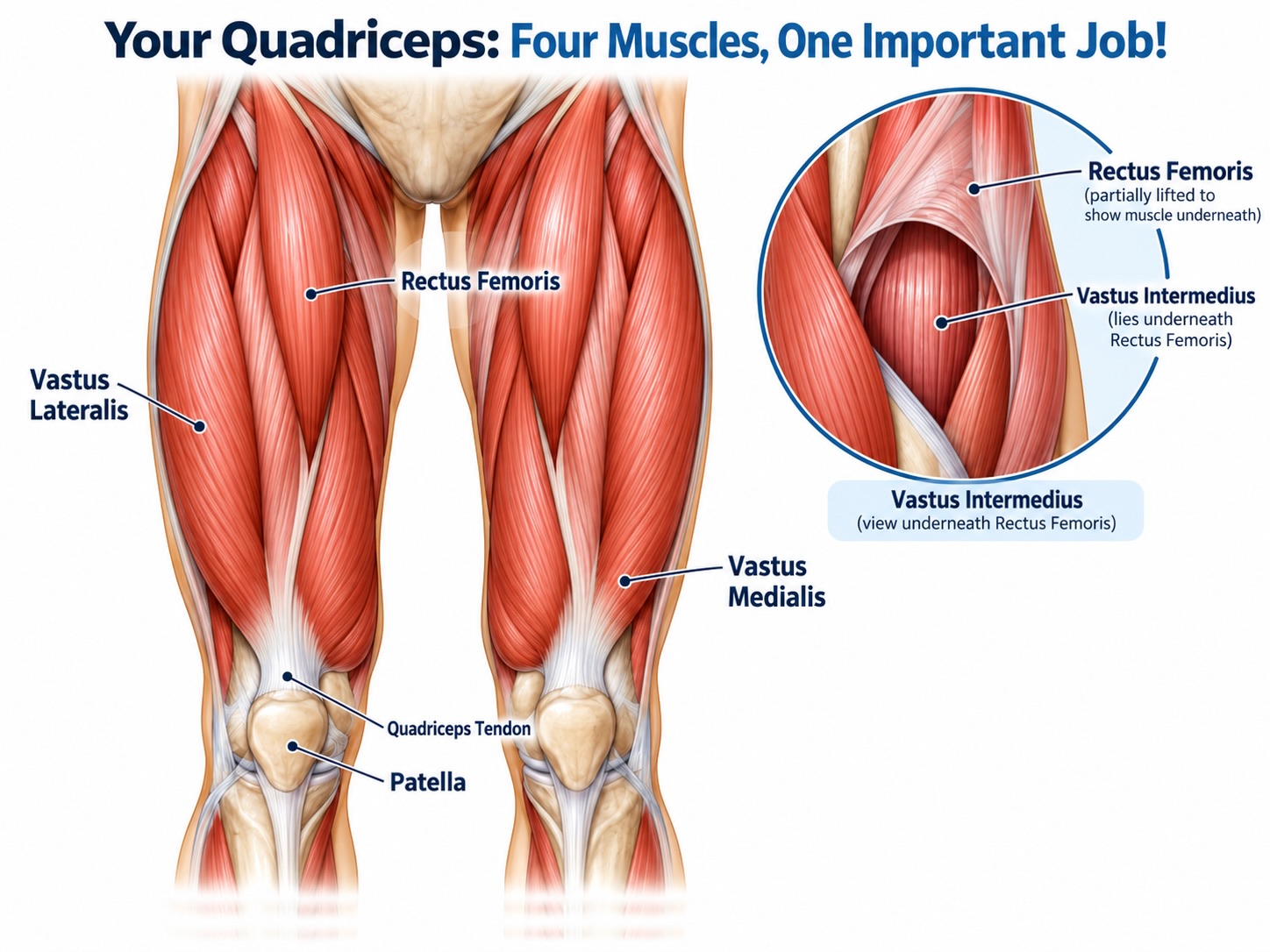
The quadriceps are a group of four muscles at the front of your thigh. Hence the name: ‘quad’ meaning four and ‘ceps’ referring to heads.
These four muscles are called Rectus Femoris, Vastus Medialis, Vastus Lateralis and Vastus Intermedius. They start from different points, but all come together to form the quadriceps tendon, which attaches to your kneecap (patella).
Below the kneecap, this continues as the patellar tendon, which attaches to the top of your shin bone (tibia).
The patella itself is quite an interesting little bone. It’s what we call a sesamoid bone, which means it’s embedded within a tendon. As you bend and straighten your knee, it glides up and down in a groove at the end of your thigh bone (femur).
This whole arrangement allows your quadriceps to straighten your knee and provides the strength you need for walking, climbing stairs, getting out of a chair, running and jumping.
Pretty important muscles, then!
What Can Go Wrong With Your Quadriceps?
Quite a few things, actually.
One common problem is pain around the kneecap, sometimes associated with the way the patella moves within its groove.
This is often referred to as a kneecap tracking problem.
Sometimes the patella doesn’t move quite as smoothly as it should, which can contribute to discomfort at the front of the knee, particularly when climbing stairs, squatting or sitting with bent knees for long periods.
Muscle strength and control can play a part, but so can the shape of the joint, the way you move and the amount of activity you’re doing.
It’s not always as simple as one quadriceps muscle being stronger than another.
What About Quadriceps Tears?
Another problem we regularly see is a quadriceps muscle strain or tear.
These can happen during activities involving sprinting, kicking, jumping or a sudden change of direction.
You might feel a sudden sharp pain at the front of your thigh, sometimes followed by tenderness, bruising or weakness.
Interestingly, only one of the four quadriceps muscles crosses both the hip and knee joints. That’s the Rectus Femoris, and it’s particularly vulnerable during activities such as sprinting and kicking.
More serious, although less common, are tears of the quadriceps tendon itself.
Occasionally, a tendon can even pull away from its attachment to the bone. This is called an avulsion injury.
A complete tendon tear is a significant injury and needs urgent medical assessment, particularly if you suddenly find you cannot straighten your knee or lift your leg when it’s straight.
How Can Physiotherapy Help?
The important thing is identifying exactly what’s causing the problem.
Is it a strain in one of the quadriceps muscles? Is the kneecap contributing to your pain? Is there a tendon problem? Or is the discomfort actually coming from somewhere else?
At The Physio Therapy Centre in Haywards Heath, our physiotherapists and sports therapists can assess your symptoms, examine how your knee and thigh are working and help identify the likely cause.
Treatment might involve hands-on therapy, specific strengthening exercises, improving movement control or a gradual return to your usual activities.
And if we suspect something more serious, we’ll advise you about the appropriate medical assessment or referral.
You can find out more about our Knee Pain Treatment, Sports Injury Treatment and Physiotherapy services.
Don’t Ignore That Pain in Your Thigh or Knee
Your quadriceps do an enormous amount of work every day, often without you giving them a second thought.
It’s only when something goes wrong that you realise just how much you rely on them!
So, if you’ve developed pain at the front of your thigh, discomfort around your kneecap or weakness that’s making everyday activities difficult, don’t just ignore it and hope it disappears.
Come in and see us.
At The Physio Therapy Centre in Haywards Heath, we’ll help you understand what’s going on and what you can do about it.
We offer free onsite parking, and you can call our friendly reception team on 01444 450162 to arrange an appointment.